
Biography
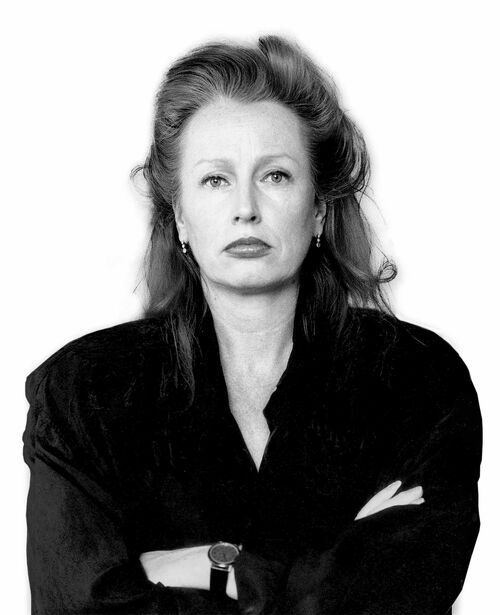
Since the beginning of the 1970s, Rebecca Horn, who was born in the Odenwald region, created an oeuvre that has developed into an ever-growing stream of performances, films, sculptural spatial installations, drawings, and photo-overpaintings. The distinctiveness of this body of work lies in the highly precise physical and technical functionality with which the artist stages her sculptures and their sequences of movement within space.
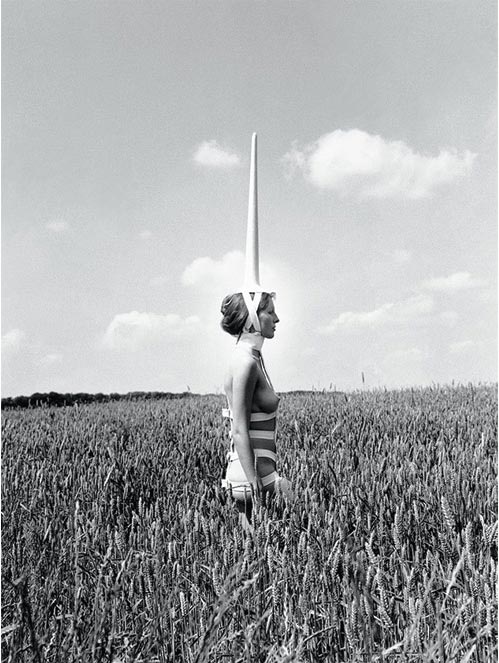
In her early performances, the body extensions, she explored the balance between human being and space. In her later spatial compositions, she replaced the human body with minimally acting kinetic sculptures. In her more recent works, entirely immaterial, she opens up the energetic field of a space through mirror reflections, light, and music.
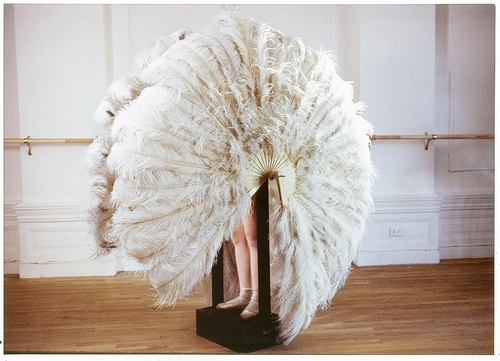
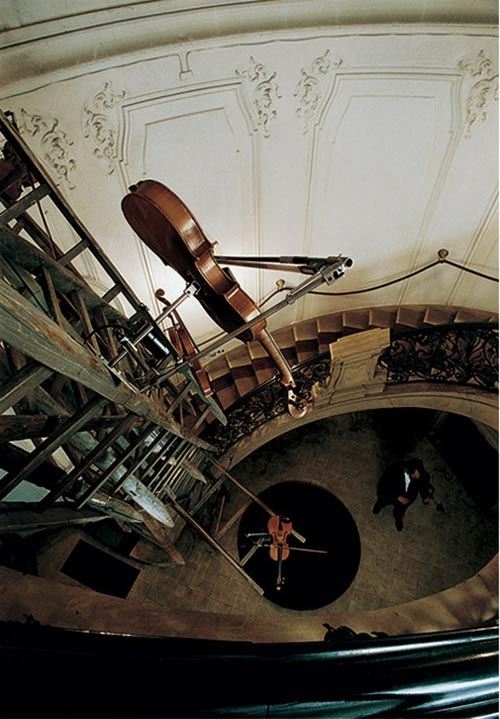
Found objects and self-constructed items such as violins, suitcases, batons, ladders, pianos, metronomes, feather fans, small metal hammers, black water basins, space-connecting spiral drawing devices, large funnels, and pumping stations form the building blocks of kinetic sculptures that are released from their defined materiality and transformed into an immaterial metaphorics of constant transformation. In this way, they offer the viewer the possibility of associating mythical images and establishing links to cultural history, literature, and intellectual traditions.
At the same time, her work is held together by a distinctive and consistent logic. Each new work seems to develop rigorously from the previous one. Elements may reappear, yet in different contexts they are transformed and appear entirely new.
Thus, following the bodily experiences of her performances with body extensions, masks, and feather garments in the 1970s, her first kinetic sculptures appeared in films such as The Gigolo (1978) and La Ferdinanda (1981): The Gentle Prisoner (1978) and The Peacock Machine (1979/82).
In the 1980s and 1990s, she created large-scale spatial works that took historically and politically charged places as their point of departure. With her kinetic sculptures, the artist now laid bare the wounds of these places, for example in The Backward Concert (1997) in Münster and Tower of the Nameless (1994) in Vienna. In Weimar, Concert for Buchenwald was created in 1999. In Mirror of the Night (1998), installed in an abandoned synagogue near Cologne, she employed the energy of writing as a form of weaving against the forgetting of history.
Working with energy can also mean visualizing the turbulences of passion as spatial magnetic currents, as in High Moon (1991) in New York or El Rio de la Luna (1992) in Barcelona.
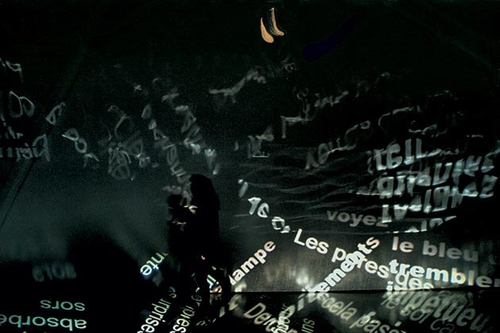
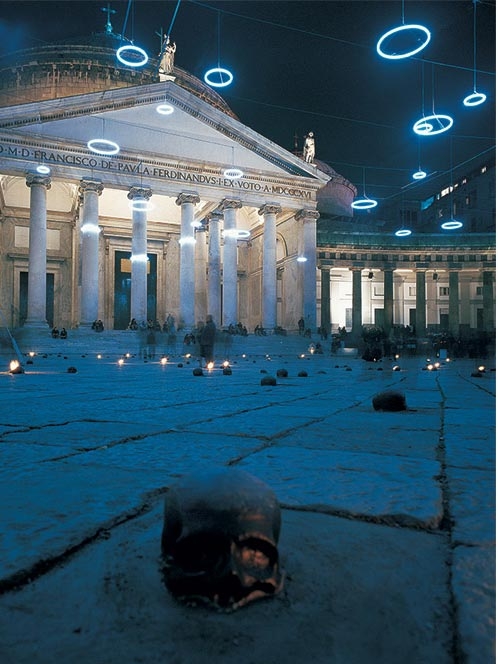
In later works, atmospheric energies such as sound structures or voices are transformed into a new immateriality of space. Examples include Moon Mirror (Palma de Mallorca, 2003), the outdoor installation Spiriti di Madreperla (Naples, 2002), and Light Imprisoned in the Belly of the Whale (2002).
Rebecca Horn’s works were presented in solo exhibitions at leading international institutions, including Staatliche Kunsthalle Baden-Baden (1981), MOCA Los Angeles (1990), the Guggenheim Museum New York (1993), the National Gallery Berlin (1994), the Serpentine Gallery London (1994), the Tate Gallery London (1994), and the Kestner Gesellschaft Hannover (1997).
Photographers
Ute Perrey
Achim Thode
Film still
Attilio Maranzano
Heinz Hefele
Peppe Avallone
Rebecca Horn
1944
born
1963
Studies at the University of Fine Arts, Hamburg
1971
DAAD scholarship at St Martin’s School of Art, London
1972 – 1981
lives in New York
1974
Teaching position at the California Art Institute, University of San Diego
1975
German Critics Award for the film Berlin – Exercises in Nine Pieces: Sleeping Under Water and Seeing Things Taking Place in the Far Distance
1977
Glockengasse Art Prize, Cologne
1979
Böttcherstraße Art Prize, Bremen
1986
documenta Prize, Kassel
1988
Carnegie Prize at Carnegie International, Pittsburgh, for The Hydra Forest, Performing Oscar Wilde
1989
Begins teaching at the University of the Arts, Berlin
1992
Kaiserring of the City of Goslar and Media Art Prize Karlsruhe
2004
The Barnett and Annalee Newman Award, New York
2005
Hans-Molfenter Prize, Stuttgart
2006
Piepenbrock Prize for Sculpture, Berlin
2007
Alexej von Jawlensky Prize of the State Capital Wiesbaden
2009
Alice Salomon Poetics Prize, Berlin
2010
Hessian Culture Prize, Wiesbaden
2010
Praemium Imperiale, Tokyo
2011
Grande Médaille des Arts Plastiques, Académie d’Architecture de Paris
2016
Member of the Order Pour le Mérite for Sciences and Arts
2017
Wilhelm Lehmbruck Prize, Duisburg
2024
Rebecca Horn passed away on September 6, 2024